What AI actually rewards
Everyone wants to know what AI can do. But the more useful question is why AI amplifies expertise rather than simply replacing it.
I think the more interesting question is:
What does AI reward?
Because two people can use exactly the same AI system and achieve radically different outcomes.
One becomes significantly more capable.
Another barely changes.
One accelerates.
Another stagnates.
One learns faster.
Another becomes dependent.
The technology is identical.
The difference is not the machine.
The difference is the person using it.
Over the last few years, we’ve become accustomed to hearing claims about AI transforming everything.
Entire industries, we’re told, will be reshaped. Jobs will change. Productivity will increase. Expertise will be redefined.
Much of that is probably true.
But after spending years working with AI systems, I’ve become convinced that the biggest differences don’t come from technical knowledge alone.
They come from something deeper.
Does AI replace expertise?
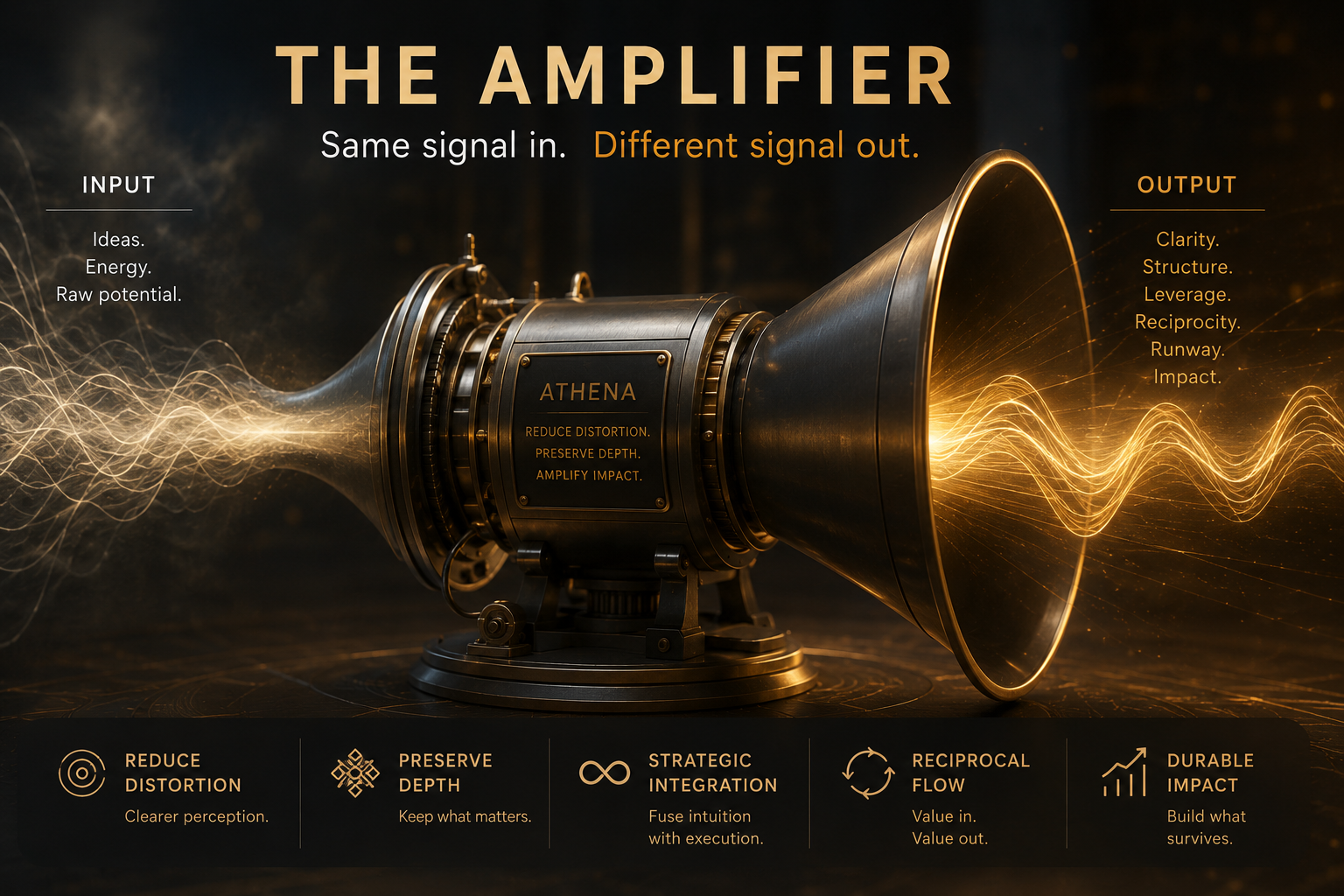
AI does not replace expertise. It amplifies it. The same AI system can produce radically different outcomes depending on the clarity, judgement, domain knowledge, and learning velocity of the person using it.
The useful question is not simply what AI can do. The better question is what AI rewards. My view is that AI rewards expertise, clear thinking, intellectual honesty, and coherent human capability.
This extends the argument from AI does not create capability; it amplifies it, and connects to the later question of how recognisable human signal survives in an age of abundant generation.
Key terms
- AI amplification: the way AI strengthens existing capability, judgement, and learning loops rather than replacing them outright.
- Expertise: the ability to evaluate outputs, spot weak reasoning, apply context, and know when the machine is wrong.
- Judgement: the human capacity to decide what matters, what to trust, what to ignore, and what to do next.
- Learning velocity: the speed at which a person can learn, test, revise, and apply new understanding with feedback.
Same AI tool, different outcome
This is one of the most interesting things about modern AI.
Two people can sit in front of the same system with access to exactly the same capabilities.
One uses it to learn faster, make better decisions, and solve more complex problems.
The other uses it to generate average content, ask shallow questions, and automate low-value work.
The gap between them can become surprisingly large.
If AI were simply a knowledge machine, this would be difficult to explain.
After all, both users have access to the same knowledge.
Yet the outcomes are different.
That suggests something important is happening.
AI may not primarily reward access to information.
It may reward how people think.

AI is not just a knowledge machine
One of the biggest misconceptions about AI is that it functions like a giant encyclopedia.
A machine containing answers.
But information stopped being scarce a long time ago.
The internet largely solved the problem of access.
Most professionals today do not suffer from a lack of information.
They suffer from a lack of clarity.
There are already more articles to read than any person can consume.
More videos than they can watch.
More reports than they can analyse.
The challenge is rarely finding information.
The challenge is knowing:
- what matters
- what doesn’t
- what to trust
- what to ignore
- what to do next
Those are not information problems.
They are judgment problems.
AI Rewards Clarity
One of the first things AI seems to reward is clear thinking.
Not perfect thinking.
Clear thinking.
People who can define a problem well tend to get better results.
People who can describe what they want tend to receive more useful outputs.
People who understand the outcome they are seeking tend to move faster than those who do not.
This isn’t really surprising.
AI systems respond to instructions.
The quality of those instructions matters.
Someone who understands:
- the objective
- the constraints
- the audience
- the context
- the desired outcome
will usually outperform someone who simply asks for an answer.
In this sense, AI acts like a mirror.
It often reflects the quality of the thinking brought into the interaction.
AI does not merely answer questions.
It exposes the quality of the questions being asked.
AI Rewards Expertise
This is where AI becomes particularly interesting.
Many people assume expertise becomes less important once AI arrives.
My experience suggests the opposite.
Experts often obtain better results from AI than novices.
Not because they know better prompts.
Because they know their field.
Give an experienced teacher and a novice teacher the same AI system and ask them to design a learning programme.
The AI may generate useful material for both.
But the experienced teacher will often recognise weaknesses, identify missing pieces, adapt the content to the learners, and ask better follow-up questions.
The difference is not access to intelligence.
The difference is judgment.
An experienced teacher can spot weak educational advice.
An experienced lawyer can identify flawed legal reasoning.
An experienced engineer can detect technical errors.
An experienced writer can recognise poor arguments.
The expert’s value increasingly lies in judgment.
Not simply knowing facts.
But knowing when the machine is wrong.
AI can generate possibilities.
Experts can evaluate them.
That distinction matters more than many people realise.
AI Rewards Learning Velocity
Perhaps the most important reward of all is learning speed.
Historically, learning and production were often separate activities.
You studied first.
Then you performed.
You trained first.
Then you applied the knowledge.
AI compresses those cycles.
Today someone can:
- learn
- test
- revise
- apply
within the same afternoon.
Questions that once required days of research can be explored in minutes.
Feedback arrives faster.
Experiments become cheaper.
Iteration becomes easier.
This changes the nature of advantage.
The advantage increasingly belongs to people who can run high-quality learning loops.
People who learn quickly improve quickly.
People who improve quickly create more opportunities to learn.
The cycle becomes self-reinforcing.
In an AI-enabled environment, the ability to learn rapidly may become more valuable than the amount you already know.
AI Rewards Intellectual Honesty
There is another quality that often goes unnoticed.
AI tends to amplify existing habits.
If someone seeks confirmation, AI can usually provide it.
If someone wants validation, it can often provide that too.
But the people who seem to gain the most value from AI use it differently.
They use it to challenge assumptions.
To identify weaknesses.
To expose blind spots.
To pressure-test their thinking.
They are willing to discover they might be wrong.
That willingness matters.
Because learning requires correction.
And correction requires humility.
The technology often rewards curiosity more than certainty.
People who approach AI as a conversation with reality tend to learn more than people who approach it as a machine for confirming what they already believe.
The hidden reward: coherence
Most discussions about AI focus on intelligence.
How intelligent the systems are.
How intelligent they might become.
How intelligent they appear.
I increasingly think the deeper story is something else.
AI rewards coherent people.
People whose goals, knowledge, judgment, actions, and feedback loops reinforce one another.
AI accelerates those systems.
It does not create them.
The people receiving the greatest benefit from AI are not necessarily the smartest people.
Nor are they always the most technical.
They are often the people who can think clearly, learn quickly, evaluate critically, and adapt consistently.
They are coherent.
And coherence compounds.
What this means for AI and expertise
The question may not be whether AI becomes more intelligent.
The more important question may be whether we become more capable.
From what I have observed, AI appears remarkably good at rewarding certain human qualities.
Clarity.
Expertise.
Curiosity.
Learning.
Judgment.
Coherence.
The technology matters.
But perhaps the deeper story is that AI is revealing what has always mattered.
The machine changes.
The underlying principles do not.
And those who cultivate them may discover that AI is not simply a tool for producing more work.
It is a catalyst for becoming more capable.
If AI rewards clarity, expertise, learning velocity, and coherence, then one question remains.
Why do some people consistently make better decisions than others, even when they have access to exactly the same information and the same tools?
In an age of abundant intelligence, judgment may become one of the most valuable capabilities of all.
Questions this raises
Does AI replace expertise?
No. AI can replace some tasks, but it often makes expertise more valuable because experts are better at framing problems, evaluating outputs, and applying judgement.
Why does AI amplify expertise?
AI amplifies expertise because the quality of the result depends on the quality of the question, the constraints, the context, and the person evaluating the output.
What does AI reward?
AI rewards clarity, expertise, learning velocity, intellectual honesty, judgement, and coherence.
Why do experts get better results from AI?
Experts know what good looks like. They can spot errors, recognise weak reasoning, ask better follow-up questions, and adapt outputs to real-world conditions.
What should people develop in an AI-enabled world?
The leverage point is not only technical skill. It is the cultivation of clearer thinking, stronger judgement, faster learning loops, and domain expertise.
Kia ora! Hey, I’d love to know what you think.