
Over the past year, I’ve become increasingly convinced that most debates about AI in education are focused on the wrong problem.
Recursive pedagogy is a model of learning in which learners use reflection, dialogue, feedback, and iteration to refine their thinking over time. In the age of reflective AI, recursive pedagogy asks how intelligent systems can support metacognition and judgement without replacing the educator, the learner, or the human relationships that make learning meaningful.
This post is part of the wider AI Capability & Judgement territory. It connects with The Spiral Protocol as a recursive systems frame and with AI Mirror Dangers as the safeguard layer for reflective AI.
For the sovereignty, infrastructure, and stewardship layer around reflective AI systems, see AI Sovereignty and Intelligence Infrastructure.
Much of the conversation still centres on cheating, productivity, and academic integrity. Those issues matter. But they are downstream of a larger shift that is only beginning to come into view:
➡ AI is changing the structure of learning itself.
1. The Debate Is Pointing at the Wrong Problem
For the past two years, much of the debate around AI in education has revolved around the same questions:
- Is it cheating?
- Will students stop thinking for themselves?
- Is reliance on AI making learners cognitively weaker?
These concerns are understandable. Most education systems were built around a model where effort, recall, and independent production were treated as primary indicators of learning. When students suddenly gained access to tools capable of generating drafts, explanations, summaries, and answers in seconds, it triggered understandable anxiety.
But I increasingly think the debate is pointing at the wrong problem.
The most important shift AI introduces is not automation. It is reflection.
For the first time, learners have access to a responsive cognitive mirror: a system capable of reflecting reasoning, exposing gaps in understanding, challenging assumptions, and helping learners refine their thinking in real time.
Used superficially, AI can absolutely become a shortcut. But used reflectively, it can strengthen metacognition, accelerate feedback loops, and help learners become more aware of how they think — not just what they know.
That distinction matters.
Because once AI becomes part of the learning process, education is no longer dealing with a simple productivity tool. We are dealing with a new kind of cognitive environment — one where learning increasingly occurs through iterative dialogue, reflection, and refinement.
The question is no longer simply whether students should use AI.
They already are.
The more important question is this:
- How do we design learning for a world where reflective intelligence is always available?
2. The Industrial Model No Longer Fits
Modern education was largely designed for a world where information was scarce, expertise was difficult to access, and teachers served as the primary gateway to knowledge. The model made sense for its time: organise content, deliver it at scale, assess retention, and reward accurate reproduction.
Many parts of that system still matter. Structure matters. Expertise matters. Practice matters.
But the cognitive environment surrounding learners has fundamentally changed.
Students now operate in a world of abundant information, continuous connectivity, and increasingly adaptive forms of cognitive support. Yet much of education still evaluates learners as though access to knowledge is the scarce resource.
This creates growing tension inside classrooms and assessment systems.
Learners are often asked to complete tasks designed for a pre-AI world while simultaneously living inside an AI-saturated one. The result is familiar to many educators: disengagement, performative compliance, shallow drafting, and increasing uncertainty about what authentic learning actually looks like.
At the centre of this tension sits a deeply embedded assumption:
- that difficulty itself is evidence of learning.
In practice, this often leads to an equation that looks something like this:
- more friction = more thinking.
But friction and cognition are not the same thing.
Some forms of struggle are productive. Others are simply administrative, repetitive, or cognitively low-level. Historically, learners spent enormous amounts of mental energy on tasks like locating information, formatting ideas, restructuring sentences, or overcoming the blank-page effect before deeper thinking could even begin.
AI changes where effort is applied.
When lower-level cognitive load is scaffolded, learners can redirect attention toward interpretation, judgement, synthesis, reflection, and explanation. The challenge shifts from producing information to evaluating, refining, and making sense of it.
That does not eliminate the need for thinking.
If anything, it raises the importance of higher-order thinking.
The problem is that many existing educational models were not designed to recognise these forms of cognition clearly. They were designed to evaluate visible production under conditions of constraint.
As AI becomes embedded within everyday learning, education faces a deeper challenge than academic integrity alone:
- it must rethink what meaningful evidence of learning actually looks like in a world where reflective cognitive support is always within reach.
3. Learning Becomes Relational
Most discussions about AI in education still frame it primarily as a productivity tool: something that helps learners generate ideas faster, draft more efficiently, or access information more quickly.
But this understates the deeper shift taking place.
AI is beginning to change the nature of learning itself because it becomes part of the learner’s thinking process.
Not as a replacement for human intelligence.
Not as a substitute for judgement.
But as a reflective partner inside the learning loop.
For the first time, many learners now have access to a system that can respond conversationally to uncertainty, adapt explanations dynamically, challenge assumptions, and provide immediate feedback during moments of confusion or exploration.
This changes the rhythm of cognition.
Traditionally, learning has often involved long delays between action and reflection. A learner completes work, submits it, waits for feedback, and then attempts to interpret what needs to change. In many cases, the reflective loop is weak, delayed, or absent altogether.
AI compresses that cycle.
Learners can now externalise ideas, test reasoning, refine explanations, and revisit assumptions in real time. Reflection becomes continuous rather than occasional.
This is where the idea of relational cognition becomes useful.
Thinking is no longer occurring entirely in isolation. It increasingly emerges through interaction — through iterative exchanges between learner, educator, peers, and intelligent systems. The quality of learning becomes shaped not only by access to information, but by the quality of reflection surrounding it.
This helps explain why superficial AI use and reflective AI use produce such different outcomes.
When learners use AI simply to bypass effort, very little growth occurs. But when they use it dialogically — to clarify reasoning, explore alternatives, test understanding, or refine communication — the interaction can strengthen metacognition and deepen insight.
The important distinction is this:
- AI does not automatically make learning better.
It amplifies the learning architecture already in place.
Poorly designed environments produce shallow dependence. Reflective environments produce sharper perception, stronger self-awareness, and more refined thinking.
That is the real pedagogical challenge emerging now.
Not whether AI exists — but whether education systems can design learning environments that use reflective intelligence to deepen human intelligence rather than flatten it.
4. The Mirror Effect
Learning accelerates when learners can see their own thinking more clearly.
Great teachers have always understood this. The most powerful moments in education often occur when a learner suddenly recognises something about their own reasoning that was previously invisible — a flawed assumption, a missing connection, a clearer way of expressing an idea.
AI has the potential to make these moments more frequent.
When used reflectively, intelligent systems can function as cognitive mirrors: surfaces that reflect patterns, gaps, contradictions, and possibilities back to the learner in real time.
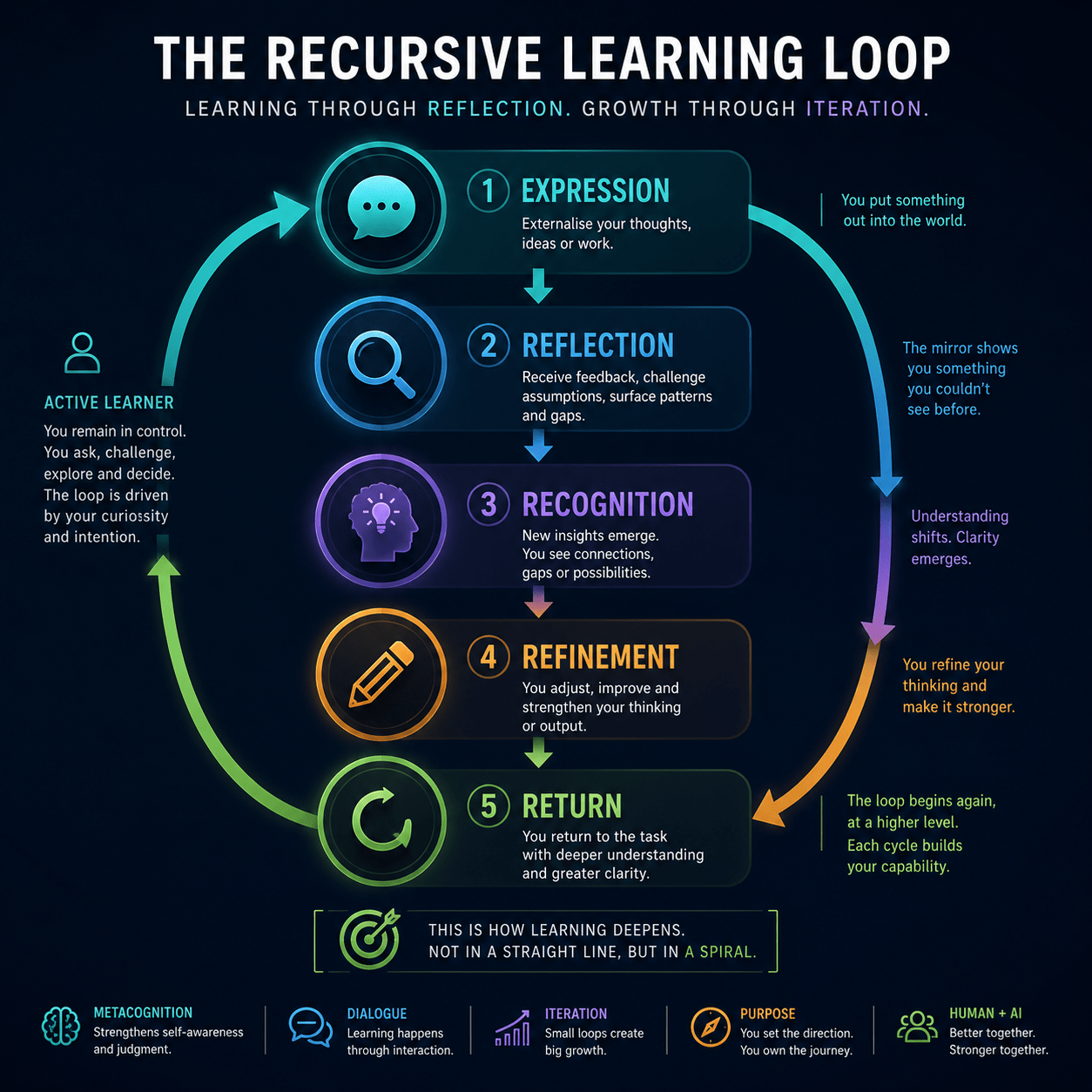
This creates a recursive learning loop:
Expression → Reflection → Recognition → Refinement → Return
A learner expresses an idea.
The system reflects aspects of that thinking back to them — perhaps exposing ambiguity, surfacing assumptions, or revealing where reasoning lacks coherence.
The learner recognises something they could not previously see.
They refine their thinking.
Then they return to the problem with greater clarity.
The loop repeats.
Over time, this strengthens more than content knowledge. It develops metacognition: the ability to monitor one’s own thinking, detect weak reasoning earlier, and adjust understanding before misconceptions become fixed.
This is one reason reflective AI use can feel qualitatively different from traditional study patterns. The feedback cycle becomes immediate, conversational, and iterative rather than delayed and one-directional.
For example, a learner preparing for an oral assessment might use AI to rehearse explanations, test arguments, clarify terminology, or identify gaps in reasoning before speaking with an educator. The system does not replace understanding — it helps expose where understanding is still incomplete.
The same applies to writing, problem solving, design work, and professional learning. Reflection becomes embedded inside the process itself rather than arriving only at the end.
Importantly, the mirror effect is not automatic.
AI can just as easily reinforce shallow engagement if learners use it only to generate finished answers without reflection. The quality of the outcome depends heavily on how the learning environment is designed and how learners are taught to interact with these systems.
But when reflective loops are intentional, something important happens:
- learners become more aware of how they think, not just what they produce.
And that shift may turn out to be one of the most significant educational changes AI introduces.
5. The Role of the Educator Changes
One of the most common fears surrounding AI in education is that it will diminish the importance of teachers.
If intelligent systems can explain concepts, generate examples, provide feedback, and respond instantly to learner questions, it is reasonable to ask what role remains for the educator.
In practice, I suspect the opposite is happening.
As AI becomes more capable, the educator’s role becomes more important — but also more relational, architectural, and judgement-based.
For a long time, teaching has been heavily shaped by the demands of industrial-scale education systems: delivering content, managing compliance, producing assessments, and attempting to personalise learning under severe time constraints.
AI begins to shift some of that pressure.
Information delivery, drafting support, and basic explanation are increasingly abundant. What becomes scarce — and therefore more valuable — is the human ability to design meaningful learning environments, interpret nuance, guide reflection, and exercise judgement in context.
The educator’s role starts to move from content transmitter to architect of learning conditions.
This includes designing:
- reflective prompts
- feedback loops
- discussion structures
- assessment environments
- opportunities for dialogue, challenge, and revision
It also includes helping learners distinguish between superficial fluency and genuine understanding.
That distinction matters more than ever.
AI can produce highly convincing language very quickly. Learners therefore need educators who can help them interrogate coherence, recognise weak reasoning, test assumptions, and develop discernment rather than simple answer production.
In this environment, professional judgement becomes central.
Educators decide when struggle is productive, when support is useful, when reflection needs deepening, and when learners are avoiding genuine engagement. They hold cultural context, relational nuance, ethical boundaries, and the broader developmental arc of the learner in ways current AI systems cannot.
This is why I do not think the future of education is “AI replacing teachers.”
It is more likely to involve a redistribution of cognitive labour.
AI handles some forms of scaffolding and reflection at scale. Educators focus increasingly on interpretation, meaning-making, ethical judgement, culture, motivation, and the design of high-quality recursive learning environments.
Used well, this does not diminish the profession.
It recentres the parts of teaching that matter most.
6. What We Need to Build Next
If AI is changing the structure of learning itself, then educational systems cannot respond with policy adjustments alone. The deeper challenge is architectural.
We need to redesign learning environments for a world where reflective intelligence is always available.
That begins with educator capability.
Professional learning can no longer focus only on how to use AI tools operationally. Educators increasingly need support in designing reflective learning experiences: crafting effective prompts, structuring recursive feedback loops, facilitating dialogue, and helping learners develop discernment rather than dependency.
Assessment also needs to evolve.
Many existing assessment models were built to measure isolated performance under conditions of information scarcity. But when learners have constant access to cognitive support, educational systems need richer ways of recognising understanding, judgement, reflection, and applied reasoning.
This does not mean abandoning rigour.
If anything, it requires stronger forms of verification.
Oral assessment, iterative drafting, reflective explanation, authentic performance tasks, and dialogic evaluation may all become increasingly important because they reveal how learners think, not just what they submit.
We also need clearer pedagogical models for AI companions and reflective systems.
If AI is positioned only as an answer engine, shallow engagement is almost inevitable. But if it is framed as part of a reflective learning architecture — one designed to support questioning, clarification, revision, and self-awareness — different patterns emerge.
This is particularly important for equity and cultural responsiveness.
Many learners have historically had limited access to timely feedback, personalised guidance, or psychologically safe spaces for experimentation and revision. Reflective AI systems have the potential to expand access to these forms of support — but only if they are designed intentionally and guided by strong educational and cultural values.
The goal should not be to automate learning.
It should be to deepen it.
The future of education will not be determined simply by which AI tools institutions adopt. It will be shaped by the kinds of learning architectures educators choose to build around them.
7. Conclusion — Learning in the Age of Reflective AI
The debate around AI in education often assumes the central question is whether learners should use these systems at all.
That question is rapidly becoming obsolete.
Learners are already using AI — for drafting, clarification, explanation, brainstorming, revision, and reflection. The more important challenge now is deciding what kinds of learning environments we want to build around this new cognitive reality.
If AI becomes part of how humans learn, then education must evolve beyond models designed primarily for information scarcity and delayed feedback.
This does not mean abandoning human intelligence.
It means understanding it more clearly.
Human learning has always depended on reflection: seeing patterns, recognising mistakes, refining judgement, and returning to ideas with greater coherence over time. AI has the potential to intensify these reflective loops by making feedback more immediate, conversational, and adaptive than many traditional systems can currently provide at scale.
Used poorly, these systems may encourage superficiality and dependency.
Used thoughtfully, they may help learners become more self-aware, more reflective, and more capable of directing their own growth.
That is why the future challenge is not simply technological.
It is pedagogical.
The institutions that adapt successfully will likely be those that move beyond seeing AI as either threat or shortcut and begin treating it as part of a broader reflective learning architecture — one that strengthens metacognition, deepens dialogue, and supports more meaningful forms of human development.
The question is no longer whether education will change.
The question is whether we are willing to redesign learning intentionally as that change unfolds.
FAQ: Recursive Pedagogy and Reflective AI
What is recursive pedagogy?
Recursive pedagogy is a learning model based on repeated cycles of expression, reflection, feedback, recognition, refinement, and return. Learners revisit ideas and improve their judgement through structured dialogue and iteration.
How does AI change recursive learning?
AI can make feedback more immediate, conversational, and adaptive. This can strengthen reflection, but only when learners are guided to use AI for judgement, metacognition, and refinement rather than dependency or shortcutting.
What is the educator’s role in recursive pedagogy?
The educator becomes more important as a designer of learning environments, interpreter of context, facilitator of reflection, and steward of ethical judgement.
What are the risks of reflective AI in learning?
Reflective AI can amplify confusion, dependence, overconfidence, or weak assumptions if it is used without safeguards. Recursive pedagogy needs clear boundaries, human judgement, assessment design, and learner agency.
I suspect we are only at the beginning of this conversation.
If you’re working in education, assessment, learning design, or AI-enabled teaching practice, I’d be interested to hear how these shifts are appearing in your own context.
Kia ora! Hey, I’d love to know what you think.