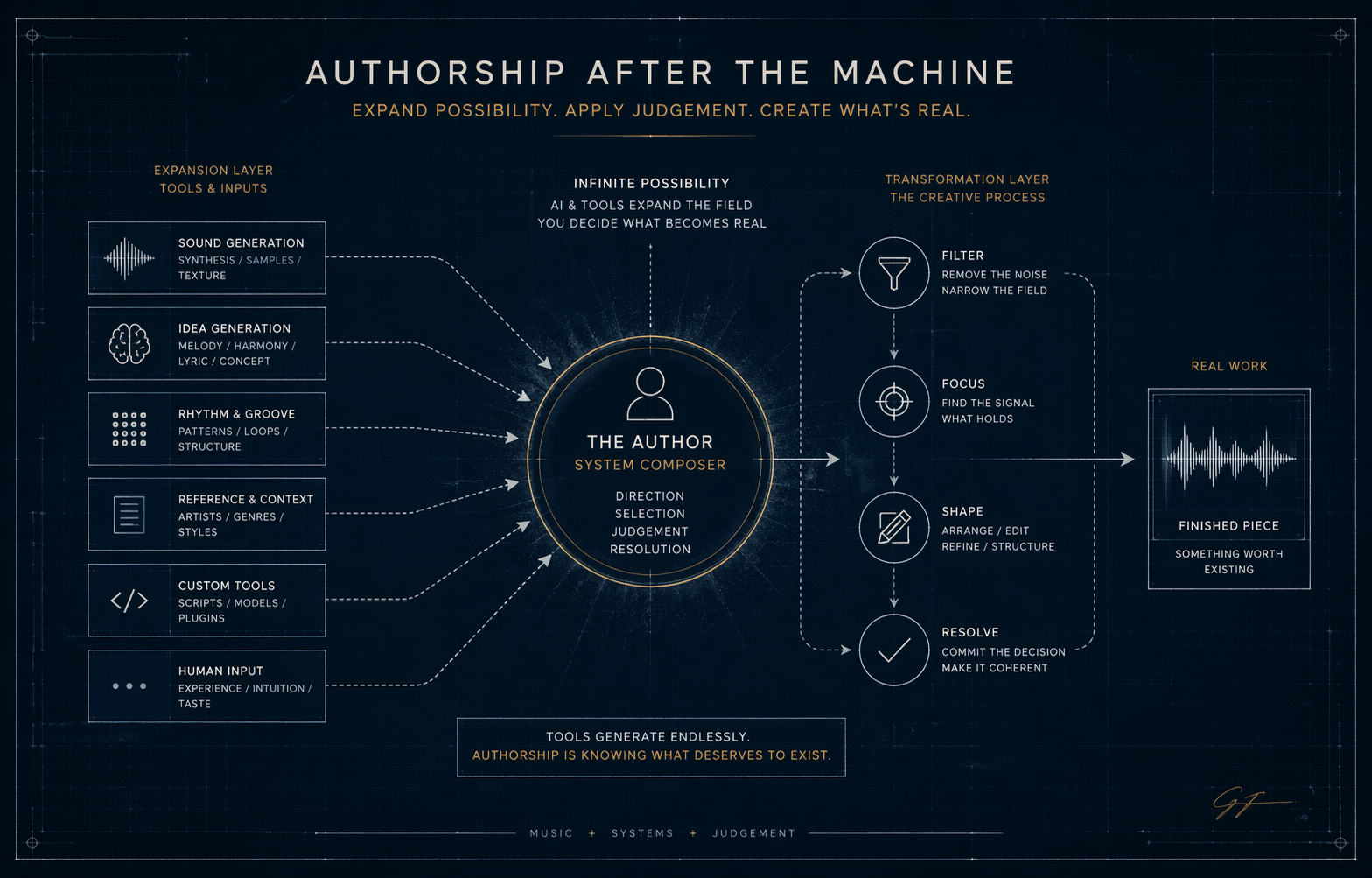
The tools have changed. The role of the artist has shifted. The work hasn’t disappeared — it’s moved.
1. Arrival
II don’t use AI to replace creativity.
I use it to expand the field of possibility — and then decide what becomes real.
This is how I think about AI music authorship.
2. The Misunderstanding
There’s a growing pressure to classify music as either:
- human-made
- or AI-generated
That distinction made sense once.
It doesn’t anymore.
Because it assumes the work happens at the point of generation.
It doesn’t.
3. Where the Work Actually Happens
In my process, the tools can generate endlessly.
That’s not the art.
The art is:
- what I choose
- what I discard
- what I return to
- what I resolve
The role shifts from execution to direction.
From control to judgement.
From making everything by hand
→ to deciding what deserves to exist.
4. A Different Kind of Authorship
I think of this as System Composition.
Not because the system replaces the artist —
but because the artist operates across a system.
Multiple tools. Multiple passes. Multiple possibilities.
Held together by:
- taste
- constraint
- intention
Authorship doesn’t disappear.
It becomes more visible — because it’s no longer hidden inside the mechanics of playing or programming.
It’s exposed in the decisions.
5. On AI as a Tool
AI increases the range.
That’s all.
It doesn’t decide:
- what is finished
- what is meaningful
- what holds together
Those decisions are still mine.
Always.
6. Why I’m Saying This Now
There’s a conversation emerging around whether artists should declare the use of AI in their work.
I understand why.
But I think the question is slightly off.
It focuses on the tool
instead of the role.
And if we stay there, we reduce something complex into something binary.
7. A Better Question
Instead of asking:
“Was this made with AI?”
A more useful question might be:
“Where did the authorship sit in the process?”
Because that’s where the work is.
That’s where the responsibility is.
And that’s where the art still lives.
8. In Closing
This isn’t about replacing the artist.
It’s about recognising that the centre of gravity has moved.
The tools can generate endlessly.
The work is knowing what deserves to exist.
(You can hear this approach in my recent releases.)
Kia ora! Hey, I’d love to know what you think.