Te Haerenga Tapatoru – An update to the Tapatoru Approach
Recently, I’ve written about what we’ve been doing in the Tapatoru programme with Ako Aotearoa. If you want to go back and have a look at any of this it’s here:
- A Closer Look at Ako Aotearoa’s Tapatoru Programme: Bringing Cultural Values to the Classroom
- Tapatoru’s Fresh Take on Professional Learning: Shaping the Future of Education:
- Tapatoru Ako Professional Practice: Empowering Tertiary Education with Ako Aotearoa’s Innovative Programme
- Celebrating the Impact of Tapatoru in Tertiary Education in 2023: Insights & Achievements
- Key Takeaways from the Tapatoru Ako Professional Practice Award: Elevating Teaching Excellence
- The Role of Tapatoru in Meeting the NZQA’s Code of Practice: Helping Providers Embrace Cultural Competency in Tertiary Education
What’s new though, is how we’ll be thinking about the Tapatoru programme from here on. That’s what I wanted to outline here.
Conceptualising Te Haerenga Tapatoru (The Tapatoru Journey)
Te Haerenga Tapatoru carries rich connotations that beautifully intertwine with the cultural and educational ethos of Aotearoa New Zealand. In Māori culture, a journey, or “haerenga,” is more than just a physical movement from one place to another.
It is a holistic process that encompasses spiritual, emotional, and intellectual growth. This concept aligns perfectly with the educational journey envisioned in the Tapatoru Programme.

Three Phases in the Journey
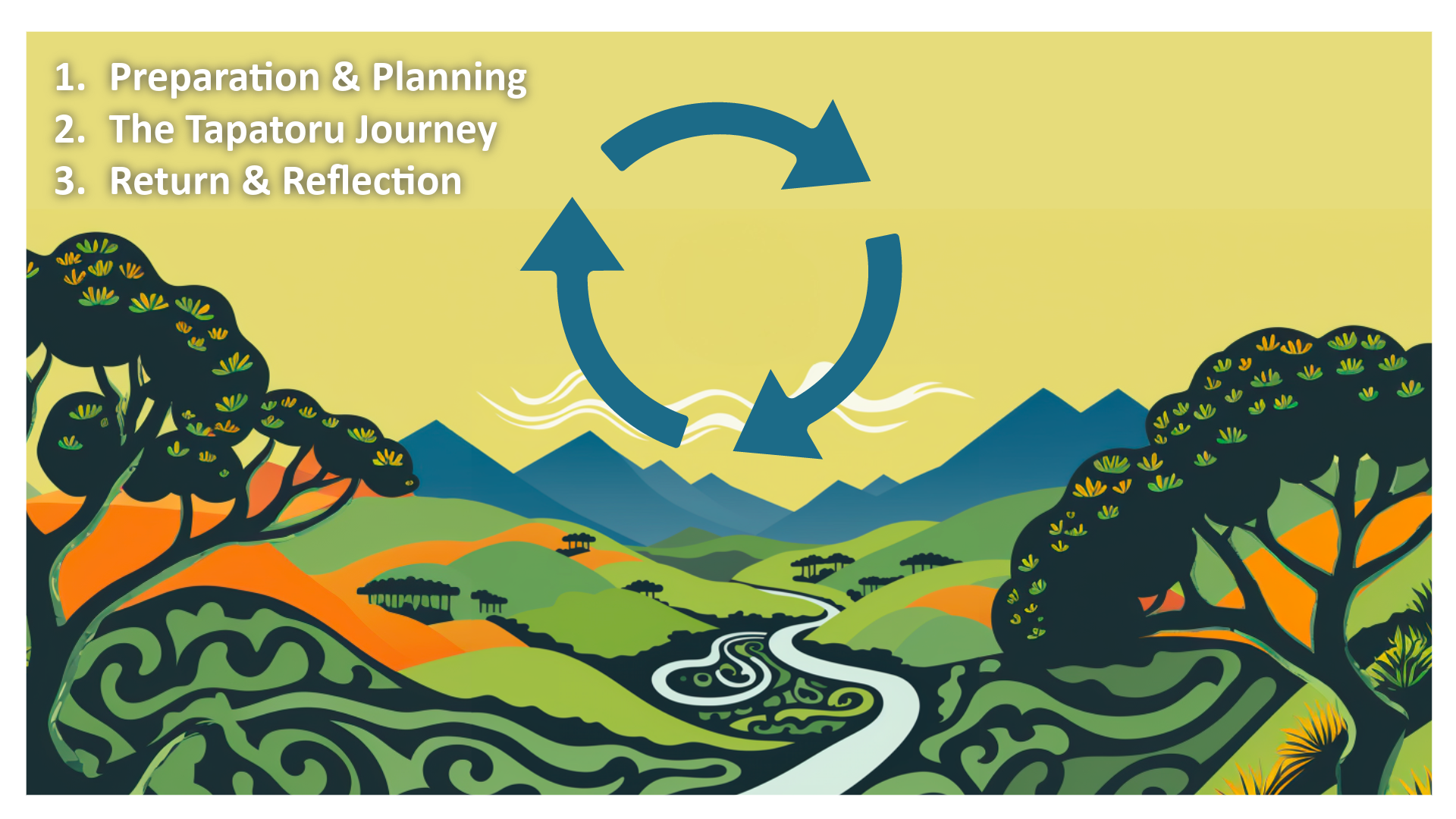
In this journey, there are three phases:
- Preparation and Planning: This is similar to preparing for a journey or expedition. This involves mapping the route (planning for the year), gathering supplies (recruiting and creating content), and training the team (regrouping and scheduling).
- The Tapatoru Journey Itself: The delivery phase is the journey where the actual exploration takes place, with all its adventures and learning experiences.
- Return and Reflection: Post-delivery is when the expedition team returns, reflecting on the journey (assessments and feedback), celebrating achievements (awards ceremony), and preparing for the next adventure.
Unpacking Te Haerenga Tapatoru
Spiritual and Cultural Resonance
In Māori tradition, journeys are often seen as pathways to greater understanding and enlightenment. “Te Haerenga Tapatoru” thus becomes a metaphor for the journey of learning and personal development, deeply anchored in the cultural values of Aotearoa.
It’s a journey that respects and integrates the principles of Whanaungatanga (relationship building), Manaakitanga (caring and hospitality), Wairuatanga (spirituality), and Aroha (love and empathy).
Narrative of Growth and Discovery
The idea of a journey inherently suggests progression, change, and discovery. In the context of the Tapatoru Programme, “Te Haerenga Tapatoru” symbolises the transformative process educators and learners undergo, evolving their pedagogical approaches and cultural competencies.
It’s a narrative of continuously unfolding layers of knowledge, understanding, and empathy towards the diverse tapestry of learners in New Zealand.
Connection to Land and People:
Journeys in Māori culture often have strong ties to the land and the community. “Te Haerenga Tapatoru” implies a journey that is not taken in isolation but is a communal experience, fostering connections among educators, learners, and the wider community.
It emphasises the importance of understanding and respecting the land (whenua) and the people (tangata), crucial in the context of New Zealand’s diverse educational landscape.
Reciprocity and Co-learning:
The concept of Ako, where teaching and learning are reciprocal, is central to our approach to education. In “Te Haerenga Tapatoru,” this reciprocity is highlighted. Educators and learners are both travellers on this journey, each contributing to and benefiting from the experience.
This journey is not just about imparting knowledge but about shared learning and mutual enrichment.
Journey as a Cycle
In many cultures, including Māori, time and progress are often viewed cyclically rather than linearly. “Te Haerenga Tapatoru” can be seen as a cyclical journey, where the end of one journey is the beginning of another.
This reflects the ongoing nature of learning and professional development – a continuous, evolving cycle of growth, reflection, and renewal.
In summary, “Te Haerenga Tapatoru” is a profound and multifaceted metaphor that encapsulates a journey of cultural and educational enrichment. It’s a journey that acknowledges and celebrates the rich heritage and diversity of Aotearoa, fostering a deeper, more empathetic, and inclusive approach to education.
Kia ora! Hey, I'd love to know what you think.