
Embedding literacy and numeracy in vocational training begins by seeing the learner, mapping the capability hidden inside an authentic task, identifying the gap between current capability and task demand, and designing a deliberate teaching bridge. The gap is not a verdict on the learner. It is the teaching work.
A few days ago, I asked a group of vocational tutors to unpack a familiar task:
Prepare a flat white during a busy café service.
At first glance, it looked simple.
Then we began asking two questions:
What does someone need to know?
What does someone need to do?
The whiteboard filled quickly.
Technical vocabulary. Sequencing. Timing. Measurement. Estimation. Equipment knowledge. Hygiene. Communication. Workflow. Customer expectations. Judgement under pressure.
One of the tutors was an experienced barista. He looked at the completed mind map, took out his phone and photographed it.
He had made thousands of coffees.
He had never seen the full capability hidden inside the task.
That moment captured something important.
The capability had always been there.
What changed was our ability to see it.
Authentic work is densely packed
Vocational tasks often look straightforward to people who have already mastered them.
An experienced worker no longer consciously notices every decision, calculation, word, sequence or judgement involved. Much of the capability has become automatic.
That is what expertise does.
It compresses complexity.
But learners do not begin with that compression. They encounter the task in its full complexity, often while also managing unfamiliar language, limited prior knowledge, anxiety, competing responsibilities and memories of earlier educational failure.
A task that looks ordinary to the tutor may feel cognitively crowded to the learner.
This is why embedding literacy and numeracy cannot be treated as separate subjects added onto vocational teaching.
They are already woven through the work.
The first step is learning to see them.
Start with the learner
Before analysing the task, we spent time examining who the learners were.
Not in the sense of claiming to know them completely.
That language now feels too certain.
A more honest starting point is to see the learner.
Seeing requires us to pay attention to:
- what learners say;
- what they do;
- what strengths they bring;
- what responsibilities they carry;
- what helps them persist;
- what may be getting in the way;
- what the evidence suggests;
- what our own assumptions may be hiding.
We used these observations to construct what I call a current best explanation.
Not a diagnosis.
Not a final judgement.
A thoughtful, evidence-informed explanation that is strong enough to guide action and open enough to be revised.
That matters because any attempt to map capability without first seeing the learner risks becoming mechanical.
A progression step is not a person.
Map both sides
Once we had spent time seeing learners more clearly, we turned towards the demands of the tasks they were being asked to complete.
This opened the central professional question:
Where do the learners currently appear to be, and what does the task require?
In many cases, tutors estimated that learners were operating across a range—perhaps around Steps 2 to 4 of a relevant Learning Progression.
The tasks, however, often demanded capability at Steps 4 or 5.
The important insight was not the precision of the number.
It was the relationship between the two.
One map described the learner’s likely current capability.
The other described the demands of successful participation.
The distance between them became visible.
The gap is the teaching work
It is easy to interpret a gap as evidence of learner deficiency.
That is rarely useful.
The gap is better understood as the location of deliberate teaching.
It tells us where learners may need:
- clearer language;
- explicit modelling;
- guided practice;
- worked examples;
- visual support;
- vocabulary development;
- comprehension prompts;
- repeated opportunities;
- scaffolded movement towards independence.
The gap is not the verdict.
It is the design brief.
This reframes the tutor’s role.
Instead of asking:
Why can’t this learner do the task?
We begin asking:
What capability does the task assume?
What evidence do I have about the learner?
What needs to become more visible or teachable?
What bridge could I design?
That is a much more productive professional conversation.
Frameworks should strengthen judgement
The Learning Progressions were useful because they gave tutors a shared language for describing capability.
But they became useful only after the group had already examined learners and unpacked authentic tasks.
This sequence matters.
When frameworks arrive too early, they can feel like content to master.
When they arrive after a genuine professional problem has emerged, they become tools.
We also used simplified capability guides as a translation layer.
The guides helped tutors notice.
The Learning Progressions helped them describe and map.
Professional judgement then helped them decide how to respond.
That distinction is important.
Frameworks should support professional thinking.
They should not replace it.
From invisible to deliberate
Many vocational tutors are already teaching literacy and numeracy.
They explain technical language.
They demonstrate sequences.
They ask questions.
They model calculations.
They check whether instructions have been understood.
They adjust tasks when learners struggle.
Much of this is done intuitively.
The next step is not to become a completely different kind of tutor.
It is to make more of that expertise deliberate.
When hidden capability becomes visible, tutors can:
- identify what successful participation actually demands;
- gather better evidence of learner understanding;
- recognise meaningful gaps;
- choose more purposeful teaching responses;
- explain their decisions to colleagues;
- improve resources without redesigning entire programmes.
That is the shift.
From implicit expertise to visible professional judgement.
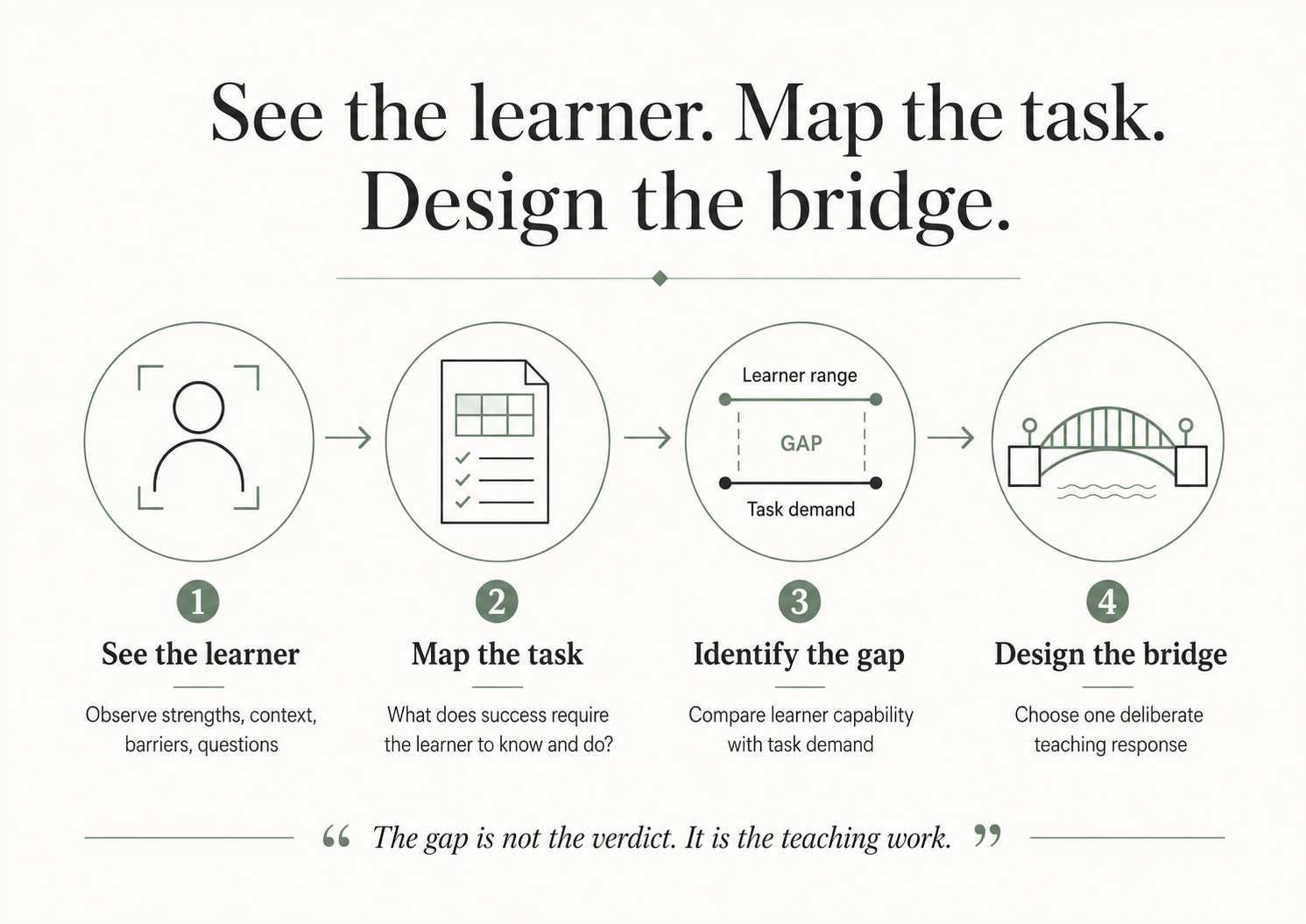
A simple model
The two days eventually condensed into four moves:
See the learner.
Map the task.
Identify the gap.
Design the bridge.
This is not a new literacy programme.
It is a professional habit.
It can be applied to a workplace task, an assessment, a workbook page, a practical demonstration, a set of instructions or an entire programme.
The task changes.
The inquiry remains the same.
The real work
Vocational tutors do not need an endless supply of disconnected literacy and numeracy activities.
They need a reliable way to decide which capability matters, what the learner may need, and what to do next.
That begins by looking beneath the task.
Then looking carefully at the learner.
Then comparing the two.
The capability is already there.
The work is to make it visible—and build the bridge.
Questions vocational tutors often ask
How do you embed literacy and numeracy in vocational training?
Start with an authentic task. Identify the language, reading, writing, numeracy and judgement it requires, compare those demands with the evidence you have about the learner, then choose one deliberate teaching response that helps bridge the gap.
Why start with the learner rather than the framework?
Frameworks are most useful after tutors have examined learner evidence and unpacked the task. They provide shared language for professional judgement, but they should not replace careful observation or reduce a learner to a progression step.
What does the gap between learner capability and task demand mean?
The gap identifies where deliberate teaching is needed. It is not evidence of learner deficiency; it is a design brief for clearer language, modelling, guided practice, visual support or another purposeful response.
Kia ora! Hey, I'd love to know what you think.