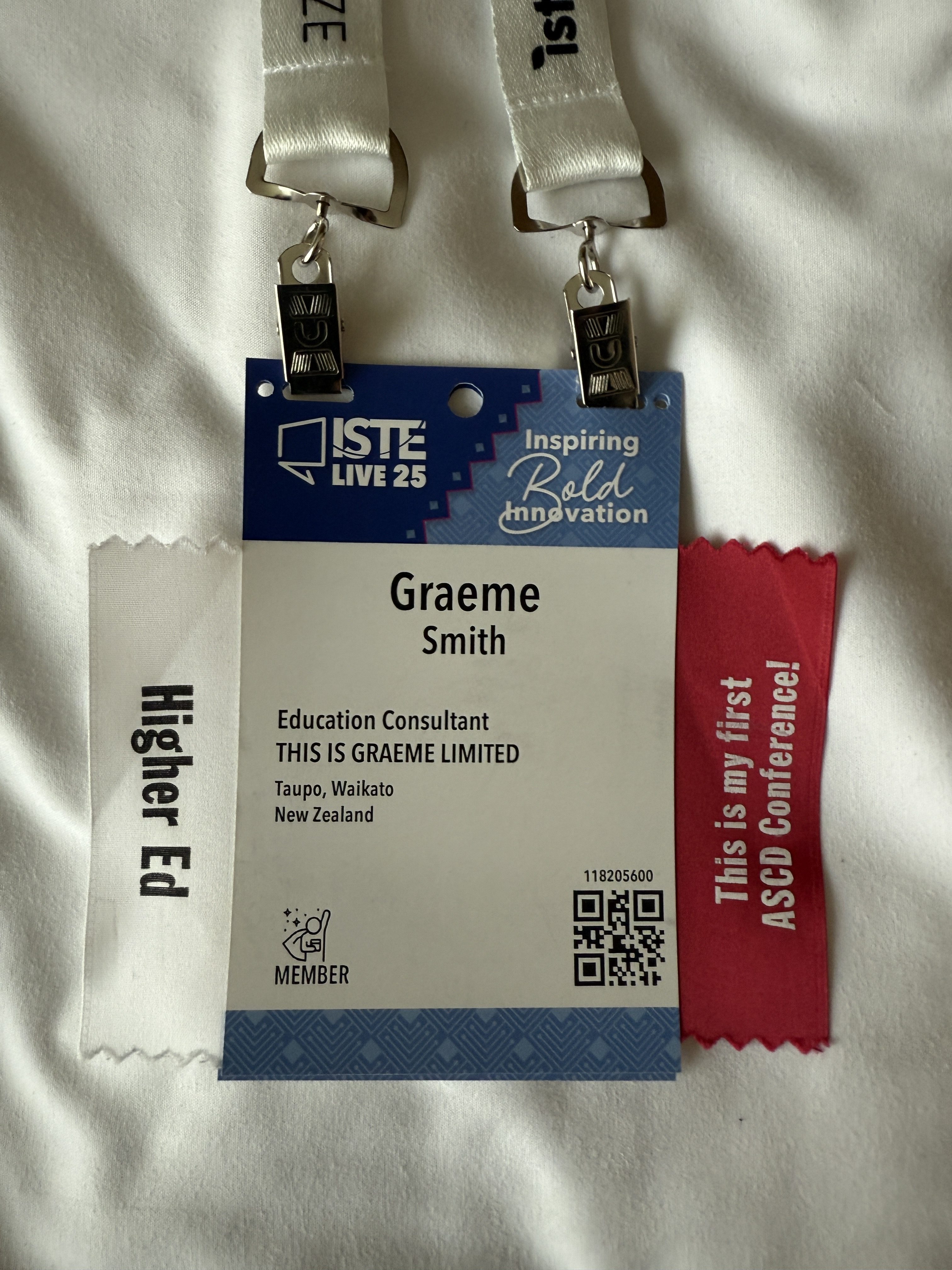
Part III of The Crossover Archives
ISTE 2025 San Antonio… Coming home from a big trip is always a strange experience.
One day you’re navigating airports and conference halls in 40-degree heat; the next you’re back in Taupō, making coffee, trying to remember which way the jet lag runs. In those first few days, San Antonio felt unreal — a city I’d visited in fast-forward, full of conversations and impressions that hadn’t yet settled.
But something had shifted.
The trip didn’t change my work overnight, but it changed the conditions inside which my work now sat. It lifted the ceiling. It widened the field. And it set off a series of developments that I can only recognise clearly in hindsight.
Here’s what the return actually did.
1. It clarified the real work of the decade
The most unexpected effect of the trip was how much clarity arrived after the plane landed.
Before ISTE, I’d been operating across multiple domains — AI, capability building, learning design, cultural intelligence, micro-credentials. All meaningful, but overlapping in messy ways. San Antonio sharpened things. It made the through-line impossible to ignore:
My work isn’t about content. It’s about building the systems, tools, and capabilities that help people adapt to an AI-shaped world.
Once that clicked, everything I was doing — including the AI companions, the micro-credential suite, the capability frameworks, and the thought leadership — suddenly belonged to the same architecture.
That clarity didn’t come in Texas.
It arrived at my desk, two days after I got home.
2. It accelerated the shift from local work to global positioning
Something subtle happens when you step into a global event, mingle with thousands of educators, and then return to your own context.
You can’t unsee the scale of the international conversation.
You can’t pretend the local debates are enough.
You can’t keep thinking in small cycles.
The return created a kind of pressure — not stressful, but undeniable.
If I wanted my work to matter at the level I now knew it could, I needed to build tools, frameworks, and publications that could stand anywhere, not just in New Zealand.
This is exactly where the next six months of work went:
- refining AI companions
- publishing more openly
- developing frameworks that hold across cultures
- writing for a global audience
- building partnerships that extend beyond national boundaries
ISTE 2025 San Antonio didn’t cause the shift.
It simply made it impossible to avoid.

3. It kicked off the most productive creative period I’ve had in years
Travel breaks routine.
Returning rebuilds it — differently.
In the weeks after the trip, I went through a burst of structured creativity:
- new AI tools
- new system architectures
- new education frameworks
- new writing
- new strategic partnerships
- new income channels
- new ways of thinking about capability, leadership, and learning
Some of the biggest projects of the year — including work on cultural AI assistants, national capability frameworks, micro-credential expansions, and architecture for teaching with AI — all trace their origins to the post-ISTE momentum.
The trip lit the fuse.
Coming home let it burn.
4. It reframed how I think about influence
Being at ISTE, you understand quickly that global influence in education doesn’t come from titles or committees. It comes from:
- showing up
- being useful
- sharing what you know
- building things people can pick up and use
- being early, but not so early that nobody understands you
- telling the truth about what’s actually happening on the ground
Back home, this translated into a stronger commitment to writing publicly — not because of visibility for its own sake, but because clarity scales when you give it away.
The return made it obvious:
If I want to shape the future of AI in education, I need to contribute to the public conversation consistently, not occasionally.
5. It changed how I think about travel itself
Before this trip, international travel felt like an interruption — something you did around your work. After this trip, it shifted into something else entirely: a strategic tool.
Travel creates perspective, and perspective fuels design.
San Antonio wasn’t a break from my work; it was part of its evolution. The return proved it. I stepped back into my environment with more altitude, more courage, and more willingness to think several moves ahead.
It made me realise something simple but important:
Sometimes you have to leave the country to understand your role in it.

6. The real transformation was not the conference — it was the recalibration
Looking back now, it’s easy to assume ISTE was the catalyst.
But the truth is quieter than that:
San Antonio exposed me to scale.
San Francisco added context.
The return did the actual work.
It’s the return where you integrate, interpret, discard, and rebuild.
It’s where loose ideas turn into frameworks.
It’s where inspiration becomes decisions.
Most people talk about trips as if the meaning happens while you’re away. But I think the real meaning shows up once you’re home — when the world you know rubs up against the world you’ve just seen.
This friction creates clarity.
And clarity creates momentum.
Closing the Archive (for now)
The San Antonio trip wasn’t dramatic. It wasn’t glamorous. It didn’t tidy anything up. What it did was much harder to describe, but far more useful: it expanded the frame of my work and reset the conditions for what came next.
If Part I was about why I went,
and Part II was about what happened,
then Part III is about what the trip enabled.
And in that sense, the trip is still ongoing.
Its effects continue in the tools I’m building, the writing I’m doing, and the version of my work now emerging for 2026 and beyond.
Sometimes you travel to learn something new.
Sometimes you travel to see something differently.
This time, I travelled to shift the ground I was standing on.
And it worked.
What I saw at ISTE wasn’t a collection of tools.
It was the early shape of a different way of learning.
I’ll be writing about that soon.
There was one more moment after San Antonio — not at the conference, but on the streets of San Francisco — where this shift became physical. A machine moving confidently through human space, indifferent to our hesitation. That encounter didn’t add new ideas. It locked the old ones into place.
Kia ora! Hey, I'd love to know what you think.