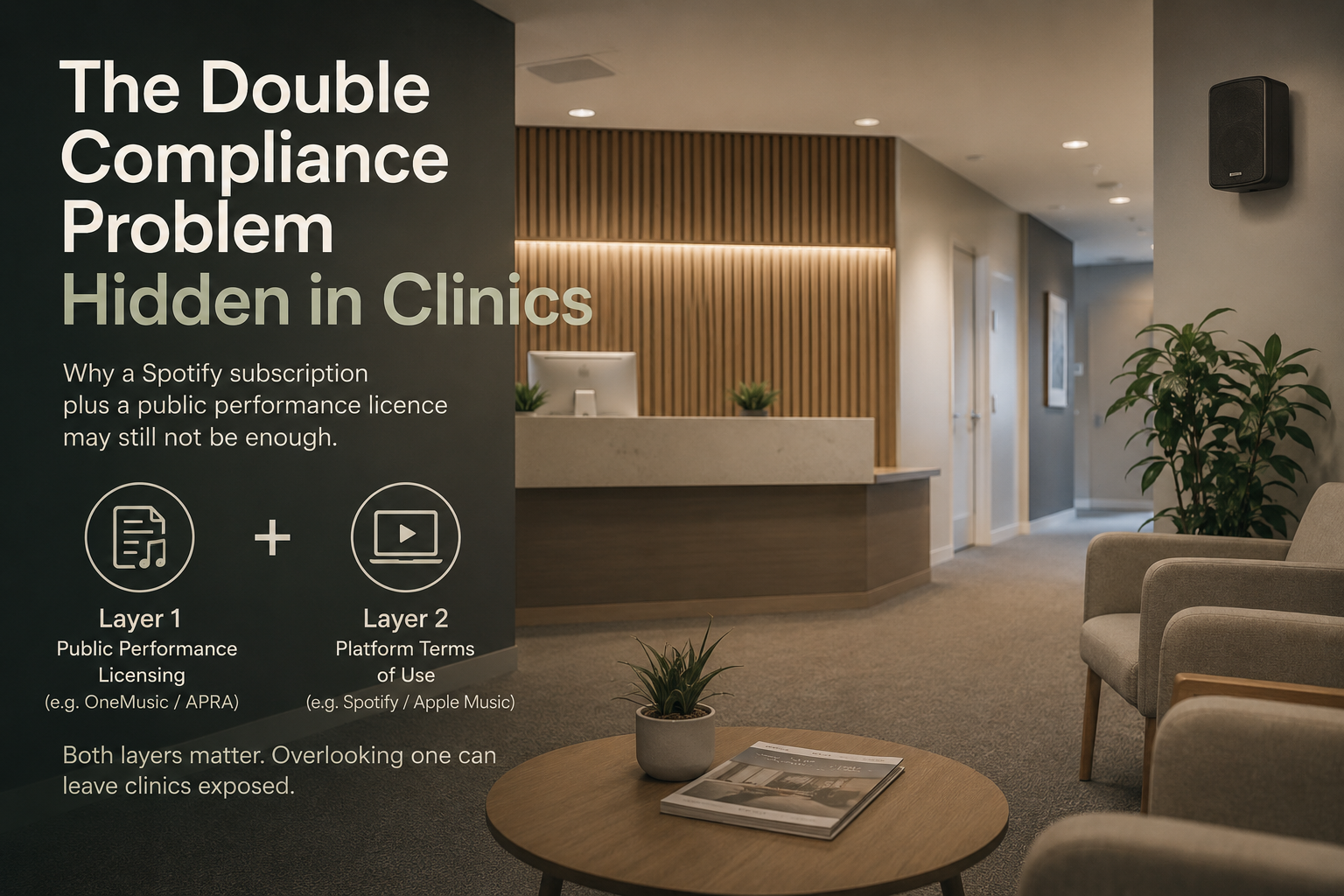
Clinics, Spotify, and the Compliance Grey Zone
Most people assume commercial music licensing works something like this:
“I pay for Spotify.”
+
“I have a OneMusic/APRA licence.”
“I’m covered.”
But after falling down the rabbit hole of audio environments in healthcare spaces recently, I discovered it’s more complicated than that.
There are actually two different layers involved.
The first layer is the one many clinics already know about:
public performance licensing.
In New Zealand, that generally means licensing bodies like OneMusic NZ, which represent rights holders and provide licences for music played in commercial/public environments.
But then there’s a second layer that many people seem less aware of:
the platform itself.
Most consumer streaming services — Spotify, Apple Music, YouTube Music and others — are designed and licensed for personal use, not commercial public playback environments.
So even if a business has public performance licensing sorted, the platform terms themselves may still prohibit the use case.
That’s the strange “double compliance” issue I kept running into while researching this space.
And interestingly, the more I spoke to clinic owners, the more I realised many had vaguely heard about this problem through forums, colleagues, or occasional calls from licensing organisations… but very few seemed completely confident about where the boundaries actually sat.
What fascinated me, though, wasn’t just the compliance side.
It was the next question.
If healthcare spaces shouldn’t simply rely on consumer entertainment platforms…
then what should they sound like?
Because once you step outside the normal “just put Spotify on” model, you start seeing the environment differently.
A clinic waiting room isn’t a café.
A consult room isn’t a retail store.
And healthcare audio probably shouldn’t behave like entertainment media.
These are emotionally sensitive environments.
People are arriving anxious, uncertain, overstimulated, vulnerable, or carrying difficult conversations into the room.
That changes the design brief entirely.
It pushed me toward thinking about audio less like “music selection” and more like environmental architecture:
low-arousal,
low-salience,
continuous,
emotionally restrained sound environments designed specifically for professional healthcare spaces.
Not foreground listening.
More like atmospheric infrastructure.
That line of thinking eventually became ENVIRON — a small experimental system I’ve been quietly building around clinical audio environments and compliant playback models.
Still early.
Still exploratory.
But I suspect this is one of those oddly overlooked intersections where:
licensing,
psychology,
environmental design,
and healthcare operations quietly collide.
And once you notice it, it’s difficult to unsee.
I’m currently piloting ENVIRON with a small number of clinics and healthcare spaces while exploring the broader compliance and environmental design questions around commercial audio.
More details here.
Kia ora! Hey, I'd love to know what you think.