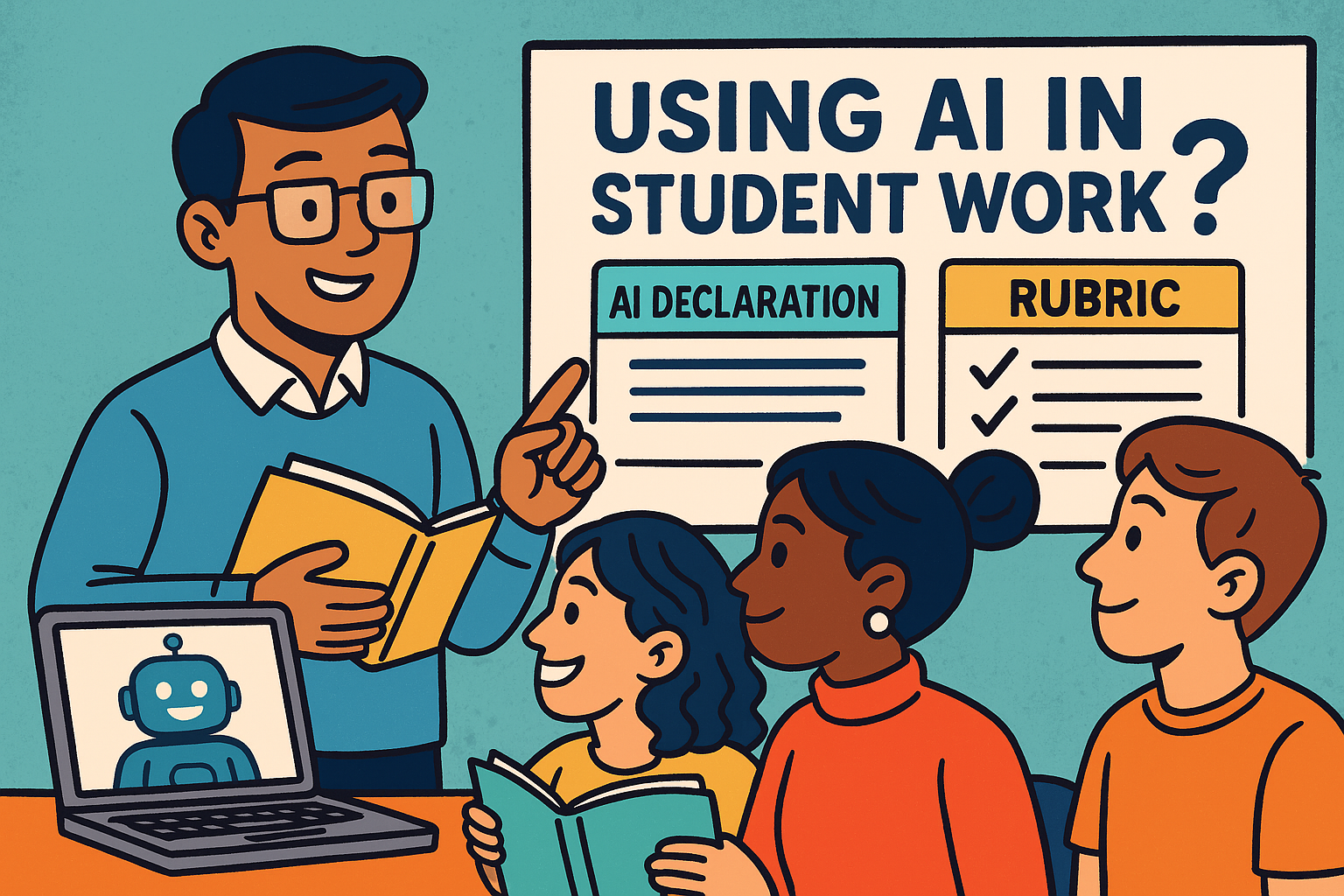

Simple templates for acknowledging AI use and assessing fairly in Aotearoa’s classrooms
Using AI in Student Work: Why This Matters
AI is here — and your learners are likely using it. Whether it’s to brainstorm ideas, summarise texts, or improve their writing, generative AI like ChatGPT is now part of many students’ learning ecosystems.
But what does this mean for assessment? And how can educators support integrity without turning into AI detectives?
This post offers two practical tools:
- A sample AI Use Declaration learners can include with submissions
- Two AI-integrated rubric examples for written and process-based tasks
📄 Part 1: Sample AI Use Declaration
This is a simple, honest statement that learners can copy, adapt, and include in their assessments.
🟢 Short Version (Minimalist Use)
“I confirm that I used ChatGPT to help brainstorm ideas and rephrase sections of this text. I reviewed and edited all AI-generated content myself. I take responsibility for the final submission.”
🟡 Medium Version (Process Acknowledgement)
“I used ChatGPT to generate a draft response to the question. I then edited the content using my own examples and added material from course readings. I have annotated any sections where AI contributed ideas or structure.”
Important: Encourage learners to treat this like referencing a source. It’s about transparency, not punishment.
🧰 Part 2: Sample Rubric Wording for AI-Aware Assessment
📘 Rubric 1 – Written Report (Level 4 or 5)
| Criteria | Achieved (✓) | Comments |
|---|---|---|
| Use of AI is acknowledged | Clear, transparent, honest | |
| Final work shows originality | Includes learner voice | |
| Edits to AI output are substantial | Evidence of reflection or revision | |
| Understanding of topic | Goes beyond surface content |
📘 Rubric 2 – AI-Supported Reflection Task
| Criteria | Achieved (✓) | Comments |
|---|---|---|
| Learner explains AI use | What tool, why, and how | |
| Critical thinking about AI | Strengths, limits, or bias | |
| Connection to course content | Links AI use to learning | |
| Personal response | Own views or insights |
🧭 Final Thoughts
AI doesn’t have to mean academic integrity is lost. With the right scaffolding, it can become a tool that strengthens critical thinking and transparency.
Feel free to adapt these templates for your context — or remix them into your own assessments and policies.
Using AI in Student Work and Want more?
Check out Ako Aotearoa’s full PDF guide on AI + Assessment (coming soon)
Kia ora! Hey, I'd love to know what you think.