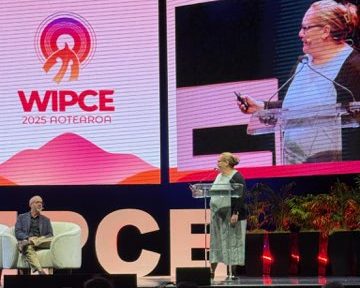

Presented at WIPCE 2025 — Auckland
Kaitiaki in the Digital Age is an example of Indigenous AI design grounded in kaitiakitanga, tikanga, Māori data sovereignty, and iwi-led environmental decision-making. The project asks how AI can support climate analysis and community capability while remaining accountable to whakapapa, whenua, mātauranga, and human judgement.
For the wider sovereignty and infrastructure frame behind this work, see AI Sovereignty and Intelligence Infrastructure.

Indigenous AI at WIPCE 2025
Last week Conny Huaki and I had the honour of presenting at WIPCE 2025 here in Aotearoa. Our session explored how Artificial Intelligence can be designed in ways that strengthen kaitiakitanga, support iwi-led climate decision-making, and uphold Māori data sovereignty.
This work belongs in two connected territories: Cultural Intelligence in Education and AI Capability & Judgement. It is not just an AI tool example. It is a case study in sovereignty, stewardship, infrastructure, and culturally grounded capability development.
This work sits at the intersection of environmental stewardship, Indigenous knowledge systems, and emerging technology — a space where the questions are complex, but the opportunities are profound.
Our guiding principle is simple:
Technology must serve the whenua — not the other way around.
🪶 Why This Matters
For many whānau, environmental reports are difficult to access.
Critical information is buried in technical language, policy jargon, and legal frameworks that were never written with Māori audiences in mind.
As a result, hapū and iwi are often excluded from decisions that impact their:
- whenua
- wai
- taonga species
- cultural sites
- intergenerational wellbeing
These exclusions aren’t intentional — they’re structural.
And AI, unless shaped intentionally, can replicate the same inequities.
🜂 Our Innovation: Kaitiaki o Ngāti Mahuta GPT
(Demonstration prototype — not publicly available)
Through our mahi alongside iwi partners, we developed an AI tool designed specifically to help whānau interpret complex environmental reports using the frameworks, values, and worldview of Ngāti Mahuta.
This prototype:
- translates dense reports into plain-language insights
- aligns everything with the Ngāti Mahuta Environmental Management Plan (EMP)
- draws on tikanga, mātauranga, and local priorities
- highlights cultural concerns and environmental impacts
- suggests mitigations based on kaupapa Māori guidance
- closes with a pūrākau-style reflection
It’s important to emphasise:
this is not a public, general-purpose GPT.
It is a customised, iwi-specific companion created for demonstration and exploration — a model of what iwi/hapū could build for themselves.
Slides from the presentation illustrate the challenge clearly:
- environmental reports are inaccessible
- critical impacts are buried in specialist language
- iwi are excluded from key decision points
- AI models reflect external values unless we reshape them
🌋 Demo: Ironsands Mining Proposal
During the presentation, we ran a live demo analysing an Ironsands mining proposal.
The Kaitiaki tool generated:
- a context summary
- a high-level overview
- key cultural and environmental concerns
- recommended mitigations
- domain alignment against the EMP
- and a closing pūrākau reflection
This showed the audience what becomes possible when AI is grounded in tikanga and local governance.
🛡️ Māori Data Sovereignty
One of the strongest themes from the session was the absolute importance of Māori-led governance over:
- data
- models
- hosting
- decision pathways
- cultural safeguards
Our next step is exploring Microsoft Aotearoa-based hosting as part of a sovereignty-first strategy.
This was a key point on slide 10:
“Māori Data Sovereignty is non-negotiable.”
🗣️ Post-Session Q&A — The Curly Questions
Many of you stayed behind afterwards with excellent questions.
Here are some of the big ones we covered:
Is this tool publicly available?
No — it’s a prototype created specifically for iwi-led exploration.
Can iwi or hapū build their own GPT?
Absolutely. We support Māori organisations through scoping, design, governance, build, and ongoing capability.
How do you ensure the AI respects tikanga?
Through Māori-led design, cultural review, red-line restrictions, and governance structures.
Where is the data hosted?
Currently in secure cloud environments, with a roadmap toward Microsoft Aotearoa hosting.
Does AI use a lot of water?
Yes — especially during training. For Indigenous communities, wai is a taonga, so transparency, hosting choice, and sustainable digital infrastructure matter.
Do you offer training or capability building?
Yes — workshops, governance frameworks, design sessions, and capability pathways.
A full extended FAQ is at the bottom of the page linked below for those who want to go deeper.
FAQ: Indigenous AI and Māori Data Sovereignty
What is Indigenous AI?
Indigenous AI refers to artificial intelligence designed, governed, and evaluated through Indigenous knowledge systems, values, sovereignty, and collective priorities rather than imposed only through external technical or commercial models.
What is Māori data sovereignty?
Māori data sovereignty is the principle that Māori data should be subject to Māori governance, tikanga, collective authority, and decision-making about how it is collected, stored, interpreted, accessed, and used.
How can AI support kaitiakitanga?
AI can support kaitiakitanga when it helps communities interpret complex information, test scenarios, protect knowledge, strengthen environmental decision-making, and surface risks while keeping final judgement with people, whānau, hapū, iwi, and kaupapa-led processes.
What makes a tikanga-aligned AI tool different?
A tikanga-aligned AI tool is not only technically functional. It is designed around relationships, responsibilities, safeguards, governance, cultural context, data location, knowledge boundaries, and the authority of the community it serves.
📺 Slides & Demo Video
You can view all presentation materials here:
👉 https://thisisgraeme.me/wipce2025-kaitiaki/
🕊️ Closing
“Kaitiakitanga extends to our data, our stories, and the code that carries them.”
This mahi is only possible because of the generosity of those who hold and protect the knowledge we’re working with.
Mihi to Conny Huaki and the Ngāti Mahuta whānau for their leadership, vision, and trust.
For the wider systems frame, see Who Participates in an Intelligence Economy, and on What Terms?. For the learning-design frame, see Recursive Pedagogy.
If your iwi, hapū, or organisation wants to explore tikanga-aligned AI pathways, climate decision support tools, or Indigenous-led tech governance, we’d love to kōrero.
He waka e hoe tahi ana — we navigate this together.

Kia ora! Hey, I'd love to know what you think.