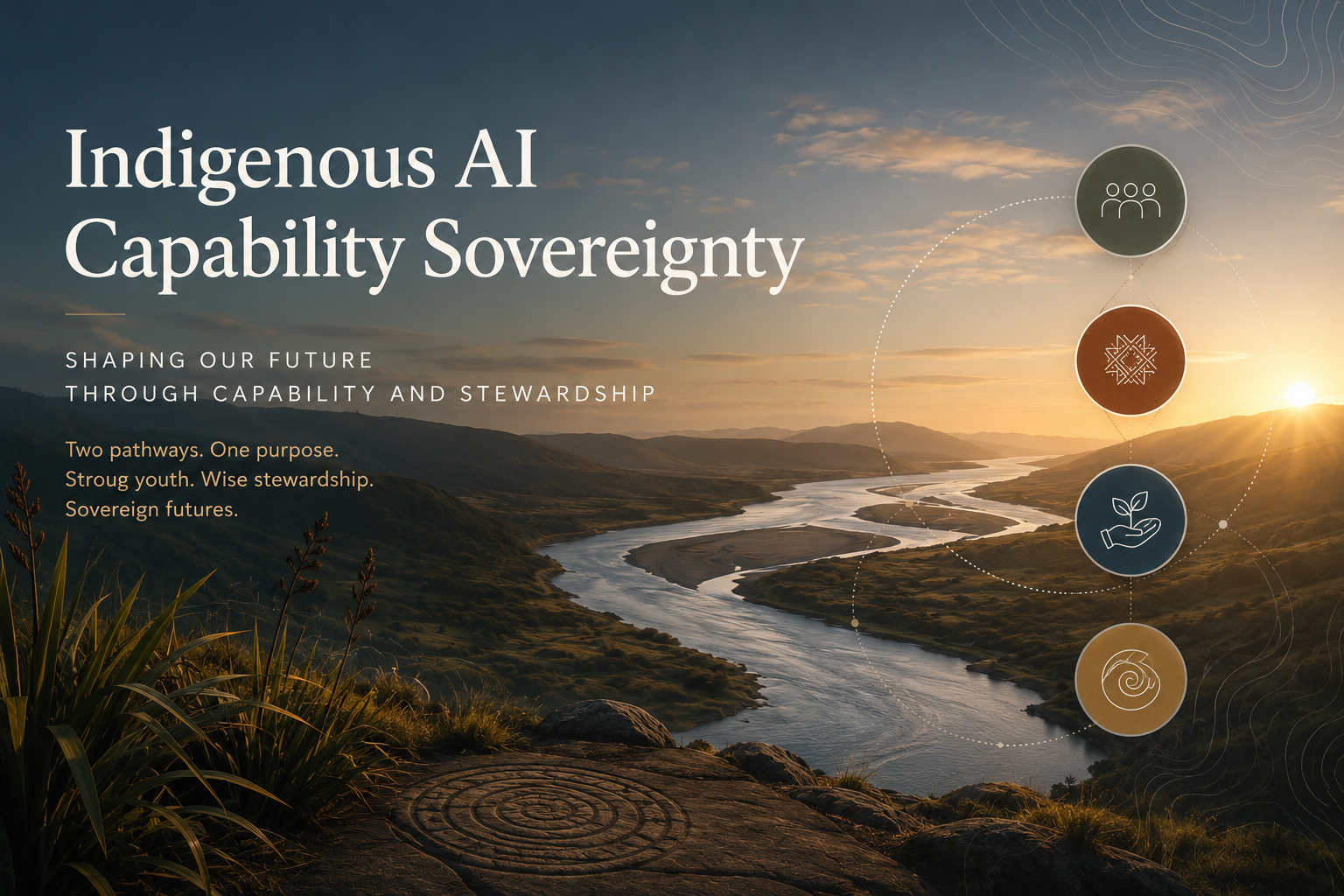
A short orientation document on Indigenous AI capability and future sovereignty
Artificial intelligence capability is accelerating rapidly across education, business, governance, media, and everyday life.
Communities around the world are beginning to ask important questions:
How should these systems be used?
Who shapes them?
What values guide them?
How do communities participate without losing language, relationships, cultural grounding, or sovereignty?
These are not only technical questions.
They are human questions.
Questions about capability, stewardship, responsibility, and future generations.
For many Indigenous communities, AI arrives with both opportunity and caution. Most systems currently emerge from outside local contexts and often reflect assumptions, priorities, and values that are not community-defined.
At the same time, new possibilities are emerging.
AI systems do not need to remain culturally blank. They can be shaped around language, worldview, governance, relationships, and community priorities. Young people can develop capability alongside cultural grounding. Communities can participate deliberately rather than passively.
Meaningful engagement does not require becoming AI specialists overnight.
The first step is orientation.
The question is not whether AI will exist.
The question is how communities choose to engage with it.
Two Pathways, One Future
Youth Capability Formation
AI capability is increasingly becoming part of how young people learn, create, communicate, solve problems, and participate economically.
This creates both opportunity and responsibility.
Communities may wish to consider how young people develop:
- critical thinking
- digital literacy
- creativity
- discernment
- confidence
- cultural grounding
The goal is not simply technical skill.
It is helping young people become capable participants in an AI-shaped future while remaining connected to identity, language, values, and community.
Young people will help shape the systems of the future.
The question is whether they do so intentionally — or inherit systems shaped entirely by others.
Community AI Stewardship
Alongside youth capability sits another important conversation:
How communities guide, contextualise, and steward AI systems over time.
This may include:
- values alignment
- governance
- trusted systems
- human oversight
- language preservation
- cultural boundaries
- economic participation
- decision-making support
The first layer of AI governance is often not regulation.
It is contextualisation.
Ensuring systems reflect the worldview, relationships, priorities, and responsibilities of the communities engaging with them.
AI systems are not neutral by default.
They are shaped by the assumptions, data, and values embedded within them.
Communities therefore have an opportunity to ask:
What should these systems carry forward?
What should remain protected?
What should guide participation?
These Are Not Separate Conversations

Youth capability and community stewardship reinforce each other.
One shapes participation.
The other shapes direction.
Together, they help communities engage with AI not as passive consumers, but as active shapers of future capability, responsibility, and sovereignty.
A Different Relationship With AI
Many conversations about artificial intelligence begin with technology.
But for communities, the deeper questions are often relational:
What values shape these systems?
Who benefits from them?
What knowledge do they carry forward?
What remains protected?
What responsibilities stay human?
One emerging possibility is the development of culturally aligned AI systems.
Rather than treating AI as culturally neutral or externally fixed, these systems can be shaped around community-defined values, language, worldview, stewardship responsibilities, and governance principles.
An early example of this thinking emerged through the concept of a Kaitiaki GPT.
“Kaitiaki” refers to guardianship, stewardship, and responsibility across generations.
The intention was not to replace people or automate decision-making.
Instead, the idea explored whether AI systems could help communities interact with complex information in ways that remained connected to their own frameworks of meaning, responsibility, and care.
This included exploring how AI might assist with:
- interpretation and orientation
- capability building
- knowledge accessibility
- stewardship support
- reviewing information through community-defined values and priorities
The significance of this work was not primarily technical.
It was relational.
It demonstrated that AI systems do not necessarily need to arrive culturally blank.
They can be shaped intentionally.
AI capability is still early.
Many important decisions have not yet been made.
The most important questions may ultimately be less about technology itself, and more about how communities choose to shape participation, stewardship, capability, and future generations in an increasingly AI-shaped world.
This work sits within a broader conversation around Indigenous approaches to AI capability building, stewardship, future participation and AI for Good.
Graeme Smith
This Is Graeme Ltd | Te Aho Lab
graeme@thisisgraeme.me
Liza Kerr-Kohunui
Kohunui Consultancy | Te Aho Lab
kohunuiconsultancy@gmail.com