Saskatchewan 2026
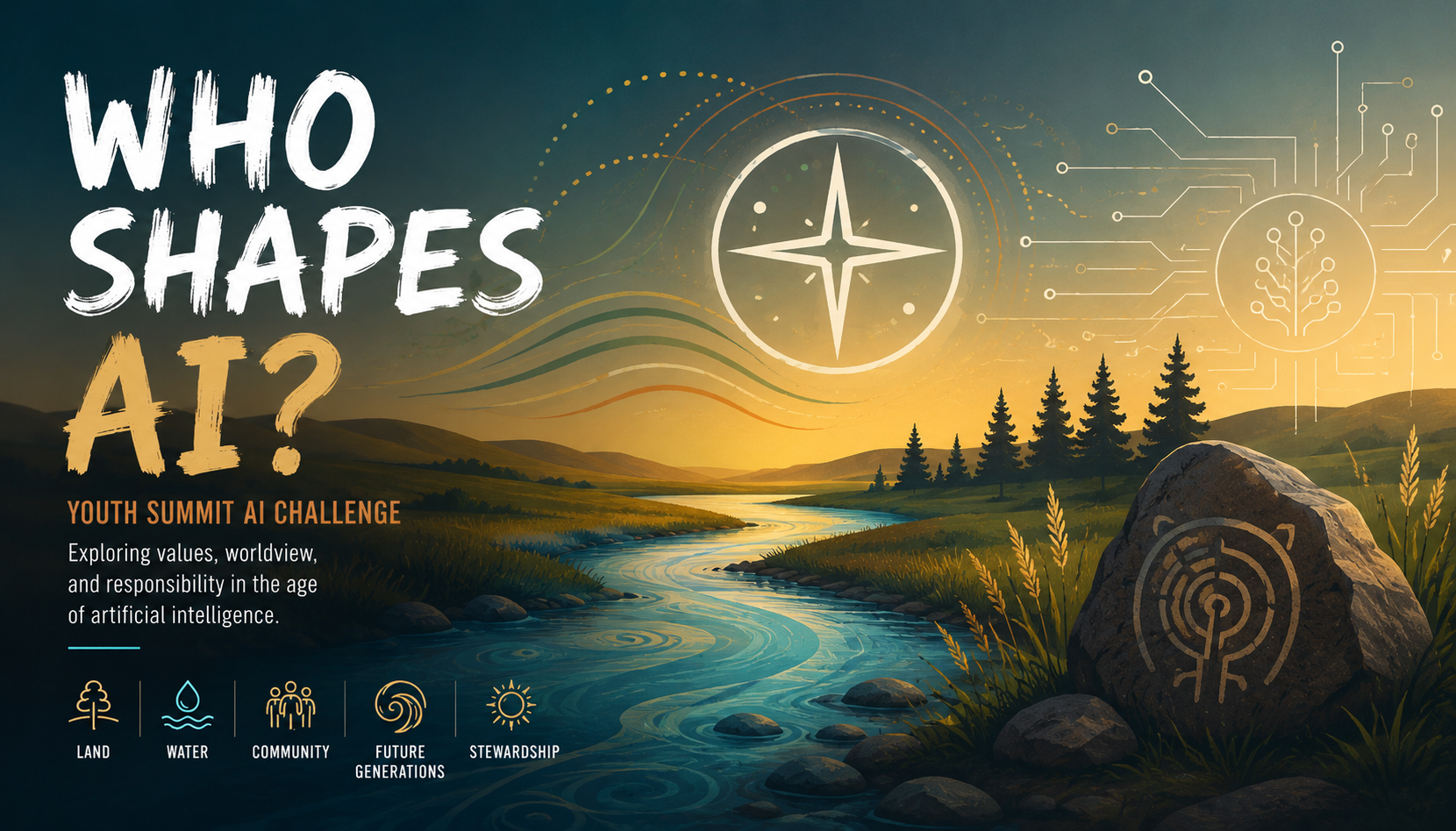
At the Saskatchewan First Nations Youth Summit, participants explored a simple but increasingly important question:
Who shapes AI?
Rather than focusing on technical AI skills or prompt engineering, the challenge invited youth to explore how artificial intelligence systems are influenced by values, assumptions, governance, and responsibility—and how communities can play a role in shaping the technologies that increasingly shape the future.
The Challenge

Working in small groups, participants compared responses from standard AI systems with responses guided by community-defined principles around stewardship, fairness, future generations, local decision-making, and responsibility.
Using a simple “AI Charter” approach, groups explored how changing the rules of a system could change the outcomes it produced.
The challenge encouraged participants to move beyond seeing AI as a neutral tool and begin thinking about it as something shaped by people, priorities, and governance decisions.
Questions Explored
Participants tested AI responses against questions such as:
- What should a community consider before approving a new data centre?
- Who should control data collected from land, water, and natural resources?
- What decisions today help create a good future twenty-five years from now?
- What responsibilities should AI systems carry?
- What knowledge should remain protected?
These questions became starting points for wider conversations about stewardship, ownership, community wellbeing, future generations, and sovereignty.
Key Insight
One of the most important discoveries was that the same AI system can produce very different answers when asked to operate under different principles.
Participants explored how:
- values shape decisions
- governance shapes systems
- assumptions shape outcomes
- different priorities create different futures
The exercise highlighted that AI is not simply a technology challenge.
It is also a human challenge.
Beyond Technology
The workshop was not designed to teach coding or advanced AI skills.
Instead, it introduced young people to ideas that sit beneath many future decisions:
- governance
- responsibility
- stewardship
- systems thinking
- critical thinking
- future-oriented leadership
Participants were encouraged not only to use AI, but also to question it, challenge it, and consider how future systems should be governed.
Reflection
A recurring theme throughout the challenge was that not all knowledge belongs inside AI systems.
As AI capabilities continue to expand, questions about boundaries, responsibility, consent, and protected knowledge become increasingly important.
The future question is not simply whether AI will exist.
The deeper question is:
Who shapes it, who governs it, and what responsibilities it carries?
Acknowledgements
Delivered in partnership with Liza Kerr-Kohunui and the Saskatchewan First Nations Youth Summit as part of the Saskatchewan Energy & Natural Resources Forum 2026.